By the Advanced Coatings Team
Both powder coating and Cerakote are durable, professional-grade finishes that outlast paint by a wide margin. They are not the same product, and they are not meant to be. Each one was engineered for a different set of jobs, and choosing the wrong one means paying for performance you do not need while missing the performance you do. The decision comes down to the part, the environment it will live in, and how much dimensional tolerance you can give up.
What Cerakote does best
Cerakote is a thin-film ceramic polymer, applied as a liquid and oven cured. A standard H-Series coat runs about 0.5 to 1 mil thick, roughly as thick as a sheet of paper. That thinness is the point. Fine engravings, serial markings, and machined tolerances survive intact because the coating adds almost no measurable dimension to the part.
Cerakote also bonds to a wide range of substrates: steel, aluminum, titanium, polymer, and even wood. That versatility makes it the go-to finish for firearms, where a single build might combine a steel barrel, an aluminum receiver, and a polymer grip. One process covers all three.
Heat resistance is another advantage. Cerakote's C-Series high-temperature formulas handle exhaust headers, turbo housings, and engine components that see sustained heat well above what standard powder coating can tolerate. For any part that runs hot, Cerakote is the practical choice.
Best for: firearms, precise or close-tolerance parts, small hardware and compact assemblies, high-heat components, and situations where the substrate is a mix of metals and polymers.
What powder coating does best
Powder coating is a thermoset process. Dry powder is applied electrostatically, then the part goes into an oven where the powder melts and cross-links into a thick, continuous shell. A standard coat lands somewhere between 2 and 10 mils depending on the application and specification, giving it significant mass compared to a thin-film coating.
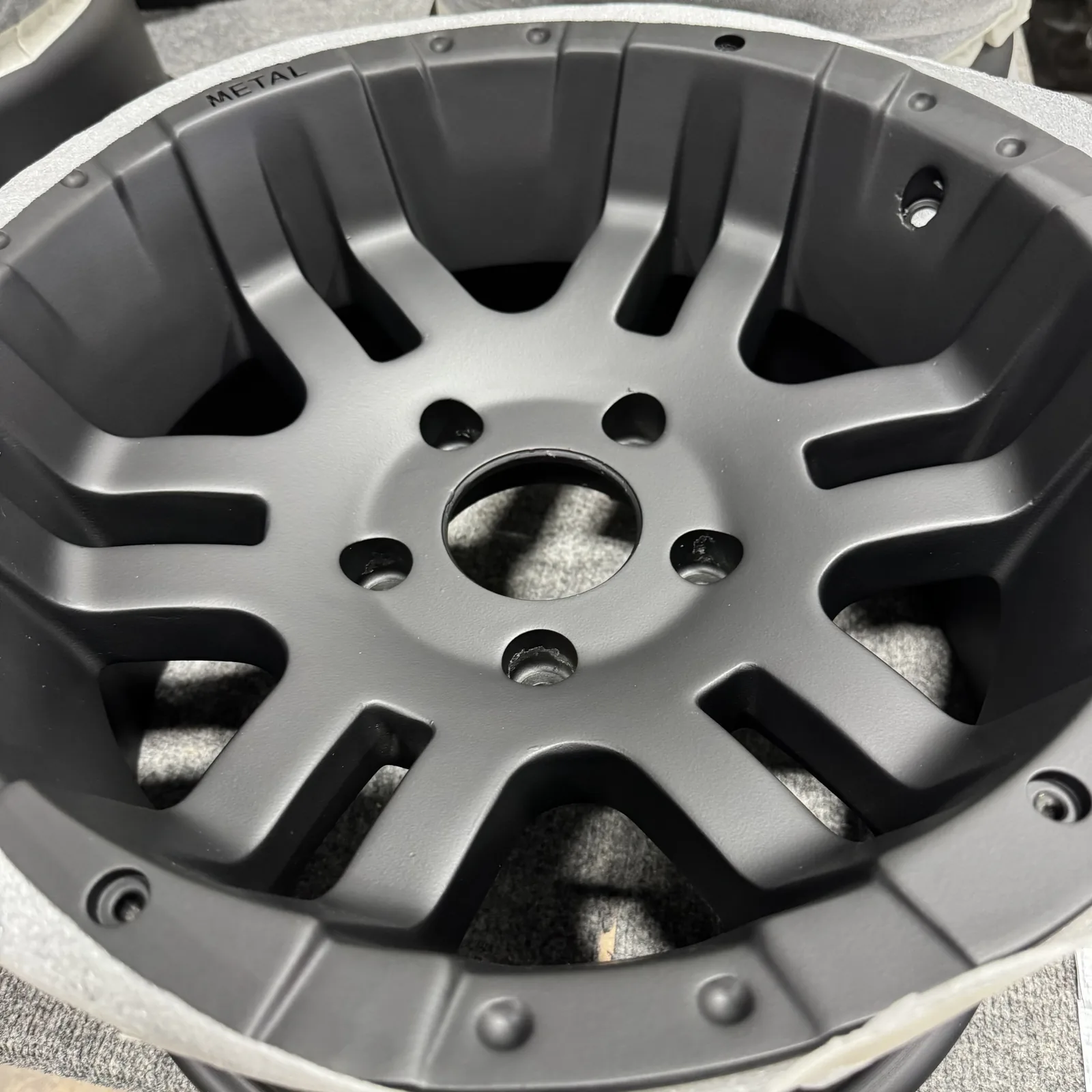
That thickness is where the impact and chip resistance comes from. On a wheel, a steel frame, or a metal railing that takes regular physical abuse, powder coating absorbs impact energy better than a thinner film. Automotive wheels, architectural components, outdoor furniture, industrial equipment, and vehicle frames all benefit from that toughness.
Powder coating also offers the broadest available library of colors, textures, and gloss levels. Matte, satin, gloss, wrinkle, candy, metallic, clear, and specialty textures are all accessible. And for larger runs of larger parts, powder coating is the more cost-effective process per square inch.
Best for: wheels, frames, railings, large automotive and industrial parts, outdoor structures, and any project where maximum impact resistance, broad color and texture selection, or cost efficiency at volume are the priority.
Side by side
| Factor | Cerakote | Powder Coating |
|---|---|---|
| Works best on | Metal, polymer, wood, mixed substrates | Metal parts (steel, aluminum, cast) |
| Thickness | About 0.5 to 1 mil | Roughly 2 to 10 mils |
| Impact + chip resistance | High per mil; resistant to chipping and scratching | Very high; thick shell absorbs hard impacts |
| Heat tolerance | Standard and high-temp series (exhaust, headers) | Standard temps only; not for sustained high heat |
| Keeps fine detail + tolerances | Yes; minimal dimensional addition | No; too thick for tight tolerances or fine markings |
| Color + texture options | Hundreds of colors; camo and patterns available | Very broad; matte, gloss, wrinkle, metallic, candy |
| Typical parts | Firearms, small hardware, compact assemblies, high-heat parts | Wheels, frames, railings, industrial and automotive components |
How to choose
Start with part size and tolerance. If the part has tight fits, fine engravings, or threads you need to keep clean, Cerakote is the right call. A 1-mil coating will not fill a groove or close a bore the way a 6-mil powder shell might.
Next, consider heat exposure. Exhaust systems, turbo components, and engine bay parts that run hot need a high-temperature coating. Cerakote's C-Series handles those conditions. Standard powder coating does not.
For large parts that take physical punishment, powder coating wins on impact toughness. A truck wheel rolling through gravel or a steel gate hinge getting slammed daily needs the mass of a powder coat shell more than it needs the thinness of a ceramic film.
For projects that mix substrate types, especially anything combining metal and polymer in the same assembly, Cerakote's material versatility is hard to match. Powder coating requires electrically conductive substrates and an oven cure, which rules out most plastics and composites.
Budget and volume factor in too. For large runs of straightforward metal parts, powder coating is usually the more economical process. For precision or specialty work, the added cost of Cerakote is justified by the performance.
Both finishes are only as good as the surface under them
A finish applied over rust, oil, or a poorly prepared surface will fail early regardless of the brand or the process. Every coating at Advanced Coatings starts with thorough surface prep: stripping old finish, blasting to a clean profile, and degreasing. The full story on why prep matters as much as the coating itself is in why surface prep makes or breaks a coating. See our process page for how we handle it start to finish.
One shop for both
Advanced Coatings runs both processes in-house at our facility in Redmond, Oregon. A customer with a mixed project, say a set of wheels for powder coating alongside a firearm build for Cerakote, does not need to split the job between two different shops. Both finishes go through the same prep standards, the same quality checks, and the same team.
If you are not sure which finish fits your parts, bring the question to us. We will tell you straight. Browse finished examples of both processes in our project gallery or request a quote and describe what you are working on.

